WHAT ARE THE BENEFITS OF ALL-WHEEL DRIVE ANYWAY?
All-wheel drive is useful precisely when grip is unevenly distributed. It improves traction by distributing the drive power to several wheels - but it does not generate any additional grip. In practice, this means that on snow, gravel, wet meadows or off-road, all-wheel drive ensures that a vehicle makes progress where a 4x2 reaches its limits. The decisive factor here is not just the all-wheel drive itself, but how the system deals with slippage - and whether there is sufficient grip via the tires.
All-wheel drive is one of those topics that is talked about a lot - and surprisingly little is really understood. On paper, it sounds simple: more driven wheels, more traction, more safety. In practice, it quickly becomes clear that it doesn't work like that. Especially in the OLLI context, i.e. where vehicles are not only driving on perfect asphalt, the difference becomes clear. There is a world of difference between an all-wheel drive that simply "runs along" and one that actually takes you further.
The crucial question is therefore not whether a vehicle has all-wheel drive. The crucial question is: what it really does for you in reality.
When all-wheel drive makes a difference at all
All-wheel drive makes a difference when the conditions are no longer clean. As long as all four wheels have the same amount of grip, it hardly matters how many of them are driven. On dry roads, all-wheel drive is therefore often unspectacular. The additional drive is there, but it is simply not needed. The difference begins the moment the surface becomes uneven.
- When you want to drive away from a damp meadow with the camper in the morning.
- When a gravel driveway is loose and rutted.
- When you drive up a snow-covered driveway in winter and one wheel is suddenly standing on bare ice.
At such moments, the grip is no longer evenly distributed. And this is exactly when all-wheel drive starts to work. It does not ensure that there is suddenly more grip. It ensures that the available grip is better utilized.
Why vehicles without traction stop
A vehicle rarely stops because it lacks power. It stops because the power cannot reach the ground. This always happens when one or more wheels lose contact or have too little grip. And this is exactly where a component comes into play that hardly anyone has on their radar in everyday life: the differential.
The differential - why one wheel can stop everything
A differential is there to allow wheels to turn at different speeds. Without this function, a car would not be able to corner. The problem only becomes apparent when the grip becomes poor. An open differential always sends the power to where it is easiest. In other words, precisely to the wheel that has the least resistance - in case of doubt, the one that is currently spinning.
The result is simple:
- A wheel loses grip.
- It spins.
- The other wheels get too little power.
- The vehicle stops moving.
This also applies to all-wheel drive vehicles. A single spinning wheel can be enough to massively reduce propulsion.
How all-wheel drive improves traction
All-wheel drive changes the starting position at precisely this point. Instead of sending the power to just one axle, it is distributed over several. This increases the chance that at least one wheel has enough grip to move the vehicle. This is no guarantee - but it is a significant improvement. This is particularly noticeable on changing surfaces. The vehicle feels smoother, pulls away more smoothly and loses propulsion less quickly.
Open differentials vs. locks - the decisive difference
This is where theory meets practice. A vehicle can have several differentials: between the front and rear axles as well as on the individual axles. And it is precisely these that can be locked - depending on the vehicle. As soon as a lock is active, the power is no longer automatically sent to the easiest path. The wheels are forced to share it.
This has a clear consequence:
- With open differentials, you need several wheels with grip.
- With locked differentials, much less is often sufficient - in extreme cases, just one.
This is precisely the difference between an all-wheel drive that "helps" and one that really makes progress.
A comparison of modern all-wheel drive systems
Many of today's vehicles operate without conventional locks.
They use:
- clutches
- brake interventions
- electronic power distribution
This works very well:
- on wet roads
- on snow
- on changing surfaces
But these systems still need one thing: grip. If a wheel is completely unloaded or spins permanently, they reach their limits. And they generate heat - you notice this at the latest when you are stuck for a long time.
4x4, 6x6 or 8x8 - does more really bring more?
More wheels mean more contact points. That helps - especially on loose surfaces or with heavy vehicles. At the same time, however, it also increases complexity. More axles mean more weight, more resistance and more points where torque can be lost. A properly constructed 4x4 with functioning locks can go further than a 6x6 with poor power distribution. The decisive factor is not the number of wheels, but the control over the torque.
Off-road and overlanding: where all-wheel drive really counts
In everyday life, all-wheel drive is often hardly noticeable. It's a different story outside. On a damp meadow, it decides whether you simply drive off or dig in. On a gravel track, it ensures that the vehicle remains calm and controlled. On easy terrain, it becomes clear whether the system can only distribute or can really handle uneven grip.
Overlanding is rarely about extreme obstacles. It's about making constant progress - without stress, without unnecessary wear and tear and without constantly driving at the limit. This is exactly where all-wheel drive comes into its own.
The decisive factor: tires and tire pressure
As much technology as there is in the drive - in the end, one part is decisive: the tires.
They determine
- how much grip there is
- how large the contact area is
- how the vehicle interacts with the ground
A four-wheel drive vehicle with poor tires is often just a heavier car. In many situations, a vehicle with good tires can do much more than you think. All-wheel drive only distributes what the tires can handle.
When all-wheel drive really pays off
All-wheel drive makes sense wherever grip is not constant. In the mountains, in snow and ice, on gravel, sand or meadows. With heavy vehicles, when traveling off paved roads or when additional load comes into play. Then all-wheel drive is not an extra. It often makes the difference.
When you can do without all-wheel drive
If you are mainly traveling on dry roads, you will hardly use the advantage. Here, weight, fuel consumption and additional technology predominate. All-wheel drive is of little use in such situations.
Conclusion: What all-wheel drive actually does
All-wheel drive doesn't work wonders. It gives you a better chance of using the available grip. It ensures that a vehicle moves forward in difficult conditions in a more stable and controlled manner. The tire determines whether there is grip. The system decides whether you use it. And that's often the difference out there.
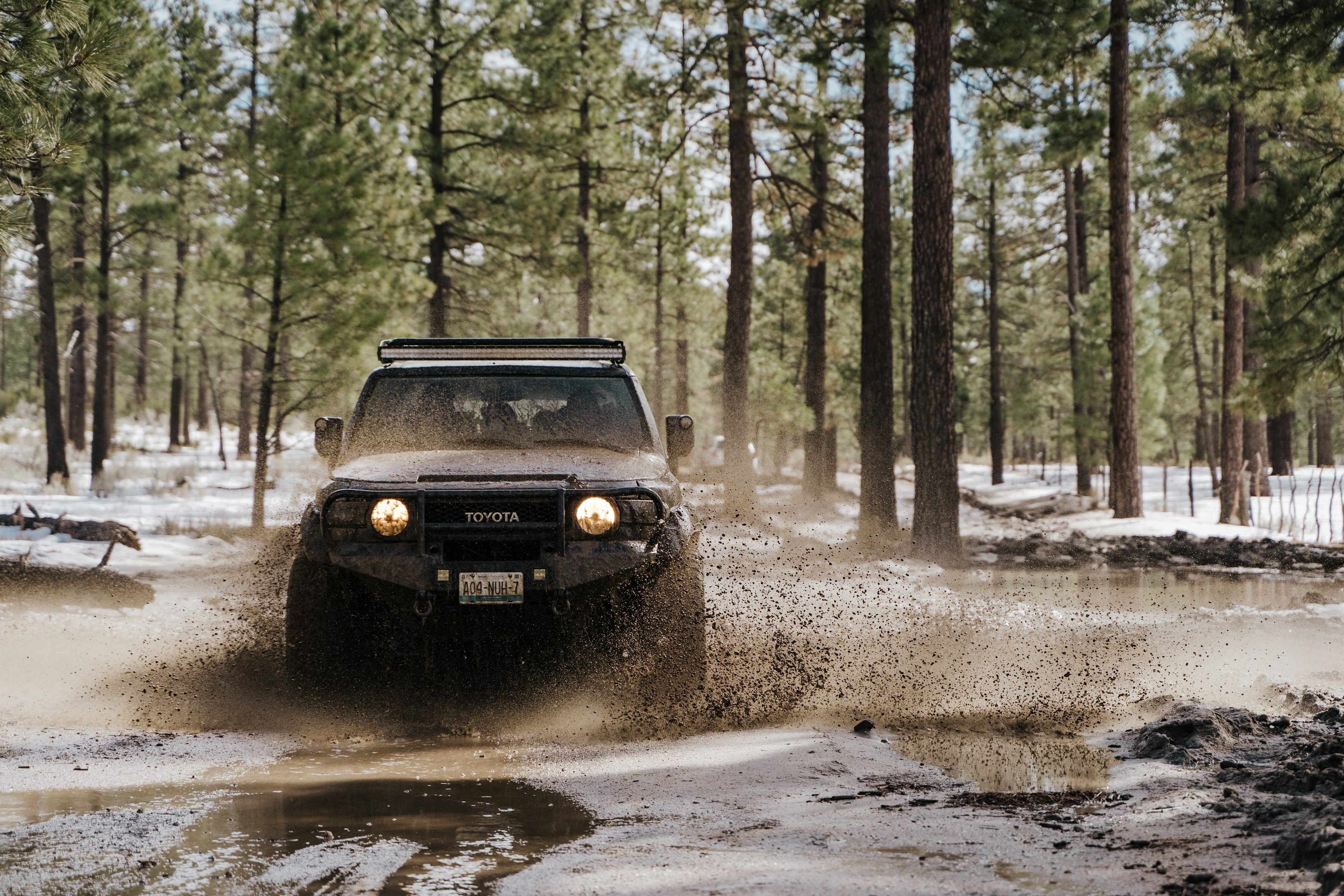
cover photo by Josue Michel, Parque Nacional Constitucion de 1857, Ensenada, México