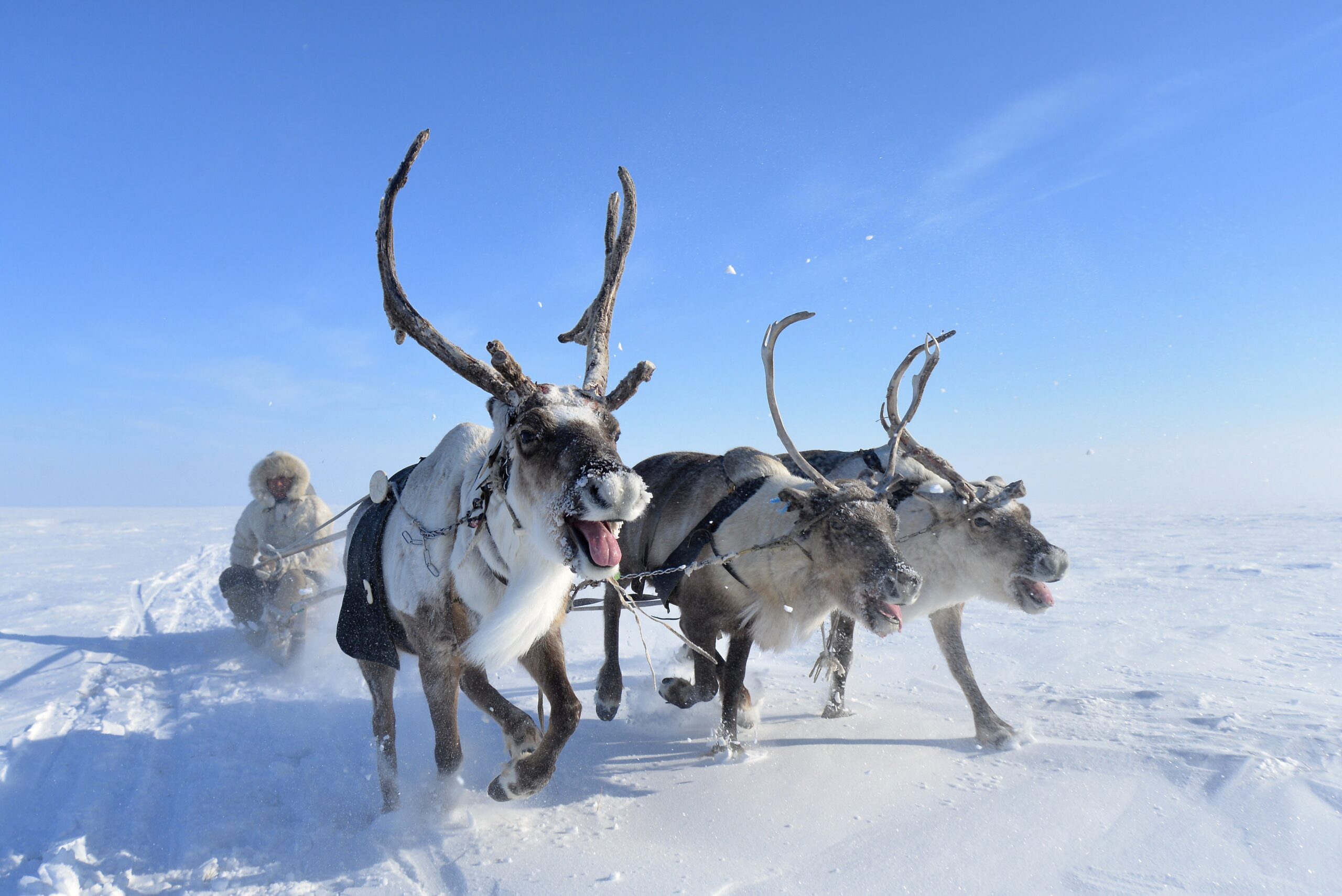
Although Sylvia Furrer and Holger Hoffmann are not "nomad novices", their stay with the Dolgans is a highlight for them. Fascinated by the wonderful landscape and the original culture, they tackle the uncertain journey in order to gain an insight into the everyday winter life of these reindeer nomads - despite the Siberian cold.
A dream becomes reality.
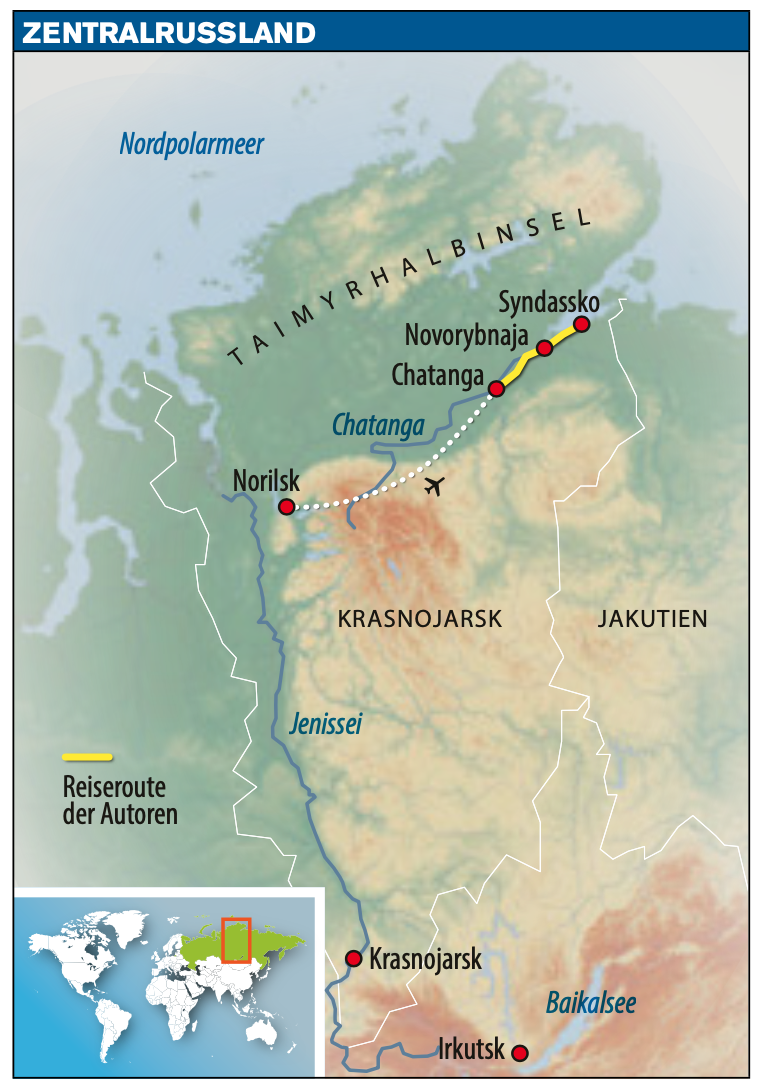
On previous trips to nomads in Siberia, we first heard about the Dolgans, a nomadic tribe living in the Chatanga River estuary. They do not live in tents, but in dwellings built directly on large reindeer sledges, the baloks. Getting to this remote area is not easy. Flights are rare, heavily dependent on the changeable weather and the massive winds that whip across the flat tundra. And in addition to an invitation, you need a special permit from the Russian secret service. The area is in a restricted military zone. We did receive this on our first attempt a year ago, but only after our visa had expired. So we try again this year, and lo and behold, this time we get it just in time.
"At minus 20 degrees Celsius, we drag our luggage across the icy tarmac and enter the airport building made of old corrugated iron."
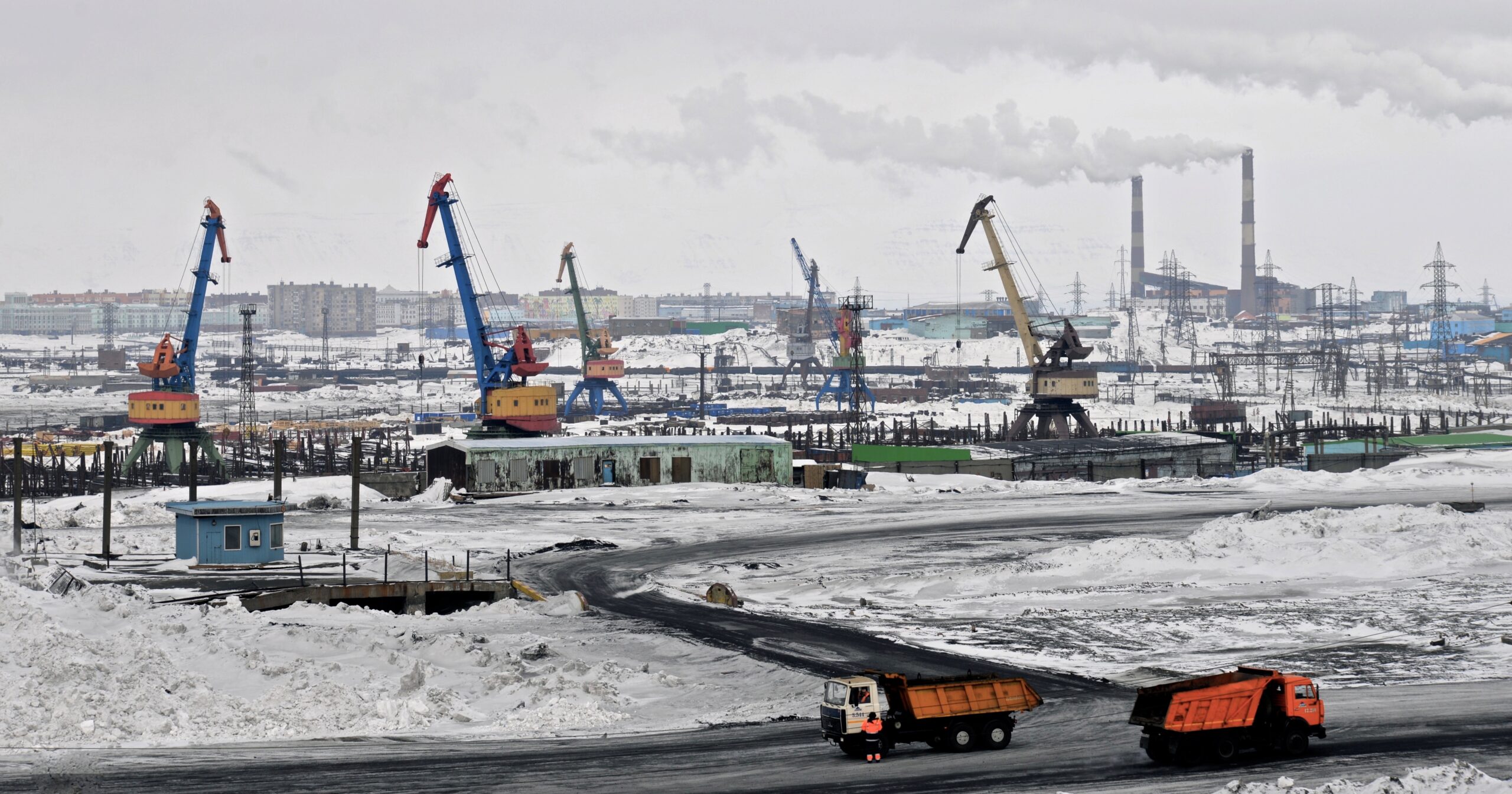
Stopovers. Russia, Norilsk - the desolate prefabricated buildings, shrouded in smoke from industrial chimneys, conjure up an image of Siberia from the old Soviet era. The town is one of the most polluted cities in the world due to nickel mining. We find it disturbing and fascinating at the same time.
The good weather allows us to continue our flight to the Taimyr Valley. We reach Chatanga in an Antonov 26. At minus 20 degrees Celsius, we drag our luggage across the icy tarmac and enter the airport building made of old corrugated iron. Masha is already waiting for us. She is our liaison between Olga, us and Spiridon, our host father. Olga, a Yakut living in Moscow, is now a loyal travel companion in the Siberian regions and has already traveled with us in Yamal. We will also be relying on her translation skills on our upcoming trip. The Dolgan culture stretches from the northern part of the Krasnoyarsk region to the Republic of Yakutia, so people can communicate in the same language. Olga speaks Russian, but it is also a foreign language for her.
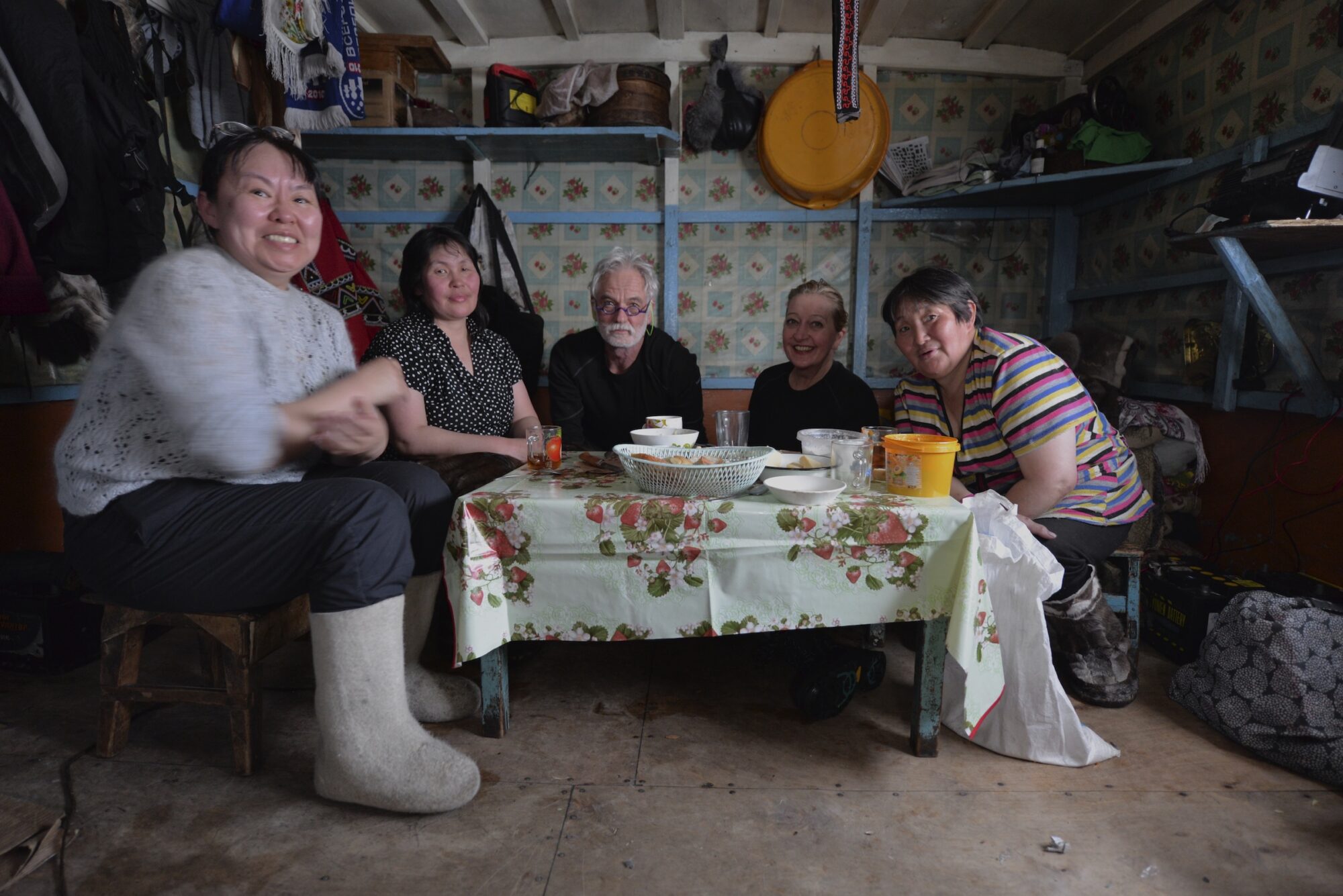
As soon as we have checked into the only hotel in Khatanga, we are told that we are expected at the local museum. Foreign visitors are rare here, so they want to take the opportunity to welcome us officially and satisfy our curiosity. Of course, this is also interesting for us. As soon as we enter, we tear off our hats, down jackets and triple gloves due to the usual Russian overheating. We are invited into a room that is already full of people. All eyes are on us. One of the older ladies invites us to join them at the table in the middle of the room. The table is richly laid with a variety of dishes and delicacies. Songs are played on the jew's harp to entertain us, and an elderly man spontaneously improvises a few songs. Today he sings about his encounter with the two Swiss and Olga.
As a parting gift, Tatjana, an elderly Dolgan woman, gives me a small bag with special contents: I should put the fish and reindeer fat it contains on a log and use it to light the stove in the balok so that the spirits will be kind to us on our journey.
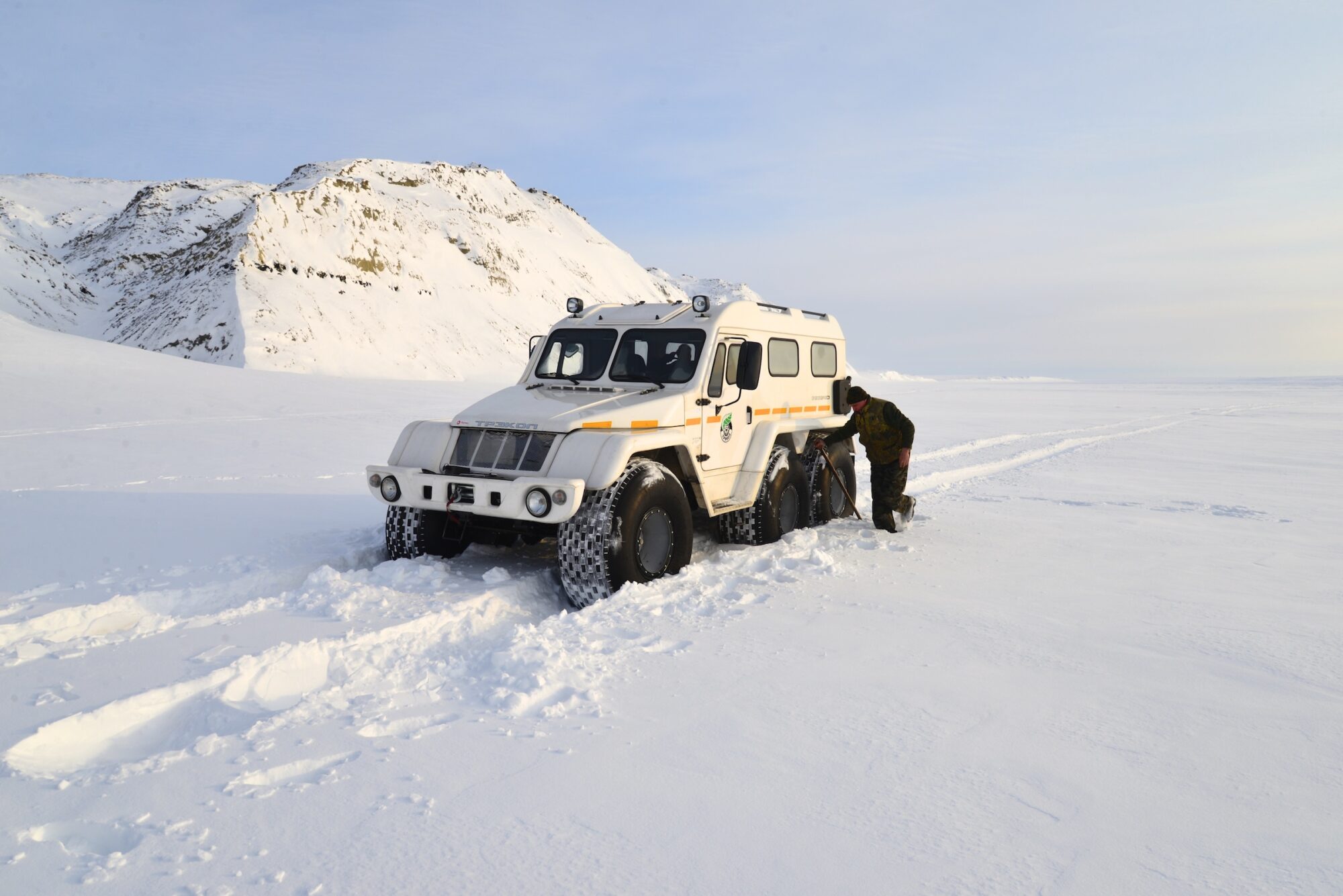

Russian robustness. We are picked up at seven o'clock sharp by Vladimir and his Trekol. We have a journey of almost 300 kilometers ahead of us on the thick ice and snow of the Khatanga River to the delta of the Laptev Sea. The Trekol is a unique Russian off-road vehicle: 6-wheel drive with oversized low-pressure tires, but miserable suspension. However, the fact that this vehicle cannot get stuck is a legend.
After more than five hours of driving through white nothingness, we arrive in the village of Novorybnaja. We are invited into the premises of the municipal administration, which are currently being converted into a school. A richly laid table with delicacies awaits us. This is always the case here when people passing through are announced by radio. There are raw fish rolls filled with garlic, deep-fried fish tails, raw salmon with onions and reindeer meatballs. We thank them for the generous food by donating a cash prize for the children's competitions at the reindeer nomad festival in two weeks' time. After filling our thermos flasks with hot tea, we continue on our way.
The snow gets deeper and deeper until our monster gets stuck by an off-road vehicle. Vladimir takes it in his stride, grabs the shovel and after the third attempt we are free again. Driving past the embankments, which glow red in the last sunlight, we arrive after a 12-hour drive in the village of Syndassko with its 400 inhabitants, the second northernmost village in Siberia that is inhabited all year round. After moving into our accommodation for the night and being served delicious reindeer meat risotto by Anna, the sister of our future host mother Irina, we meet Nina Porotova, the enterprising mayor. She praises her village as being 100 percent inhabited by Dolgans.
The next morning, we stroll through the village, which consists of uniform, single-storey wooden houses. The dwellings have a kitchen and a living room/bedroom. The anteroom is also a coal and wood cellar and a place to store the ice blocks for drinking water. The ice blocks are chopped up and placed in a pot next to the stove to thaw. The "mobile toilet" consists of a bucket that is kept in the ice-cold coal cellar. After doing your business, you simply empty it onto the street. When I "have to" for the first time and then step out onto the street with the bucket, a pack of dogs runs expectantly towards me.

We stock up on a few bottles of vodka for our host family and fruit and sweets for the children in the only small grocery store in the village. A detour to a small hill offers a beautiful view of the surrounding area. The cemetery is also located here. Because of the permafrost, the coffins cannot be buried in the ground, but are placed on sledges. The snow then covers them like a blanket. In the past, the shamanic religion of the Dolgan mixed with Christianity, and so today an Orthodox cross stands guard over each coffin.
Where are we going? After lunch, we set off with Anna, her children and Mikhail, Spiridon's eldest son, on two Buran (snowmobiles) with attached transport sledges to our nomadic host family. The 40-kilometer journey should take about two hours. Holger and I put on our down overalls for the first time, which not only have a zipper at the front, but also one at the back - which is a great advantage, especially for me as a woman in the cold. After half an hour, the Buran with the luggage sledge gives up the ghost. Mikhail is unsure how long the repair will take, so he sends us ahead with the other driver. The landscape is slightly hilly, the sky overcast. The eye finds no fixed points, no trees or bushes, everything is white. After two hours of driving, it starts to snow and the horizon disappears, as does the track. Anna occasionally consults with the driver - but they don't seem to agree on where we can find Spiridon's family. The directions "straight ahead and then left" are probably a bit vague. In situations like this, I try to convince myself that these people are at home here and know exactly what they're doing. A short detour to the next hill leads to salvation. The driver has spotted the Baloks on the horizon in a cloudless moment. As we learn later, there is a safety net. Anyone setting off with a Buran must report this by radio. If they do not arrive at their destination within a reasonable time, a search is launched.

After another hour, we reach Spiridon's family's campsite. The joy of finally getting to know each other is great on both sides. In one of the baloks, we take a seat between the assembled family members - Spiridon and Irina, the second son Makar, the daughter Dasha with her husband Ivan and the two children Irma, aged seven, and Markel, aged three and a half - on the reindeer skins spread out on the floor. While Irina prepares tea and food on the small stove in the corner, we study the construction of the dwelling. The beams and walls are made of wood, with a layer of reindeer skins stretched over them for insulation. The outermost layer is made of canvas to protect against the weather. In addition to the stove and the furs, which serve as a base for sitting and sleeping, there is also a low table, three stools, a few pots for the melting water and other kitchen utensils hanging from the wall or ceiling. There is a radio next to the window. We can hardly believe it: ten adults and six children are sitting comfortably together in an area measuring three by four meters. When Mikhail turns up an hour later with the luggage sledge, it gets even more crowded. Irina distributes the sweets she has brought with her. The oranges are particularly popular. The children eat them with gusto. As we wonder how all these people are going to spend the night, Olga reassures us: we will sleep in a separate balok.
After a soup with large pieces of meat to be carved with a knife and delicious slices of reindeer tongue, Holger and I walk the few meters over to "our" balok for the first time. It is now just after eight and we witness a dramatic sunset light show. We enter the somewhat smaller dwelling through the curtained windbreak. Holger and I settle in on one side of the table, Olga on the other. We put our sleeping bags on the soft reindeer skins. In the meantime, Mikhail has stoked up the fire. The energy situation for the Dolgan in the Syndassko area is downright comfortable. There is a vein of hard coal on the opposite bank of Syndassko, which the Dolgans are allowed to mine for free. The rivers also carry plenty of driftwood to the banks.
Sledge training. Around 10 p.m. it is still a little light. The rule for the night is: if you wake up, add a few logs. The toilet is behind the balok in the snow, including the barking of dogs at night. Because Olga needs a coffee first thing in the morning, we soon have a warmed room and hot water for our first tea. We are invited into the main balok for breakfast. Irina is on the radio - as she is every hour on the hour, communicating with the neighbors' distant stands. Despite occasional cell phone reception, people prefer to rely on the radio. The latest gossip is exchanged as well as important information, such as whether someone is off with the Buran and is expected soon. Irina offers us boiled reindeer heart and hot tea. I like it, and I mention that I also really like bone marrow. From then on, I always get a special portion of marrow bone, raw or cooked.
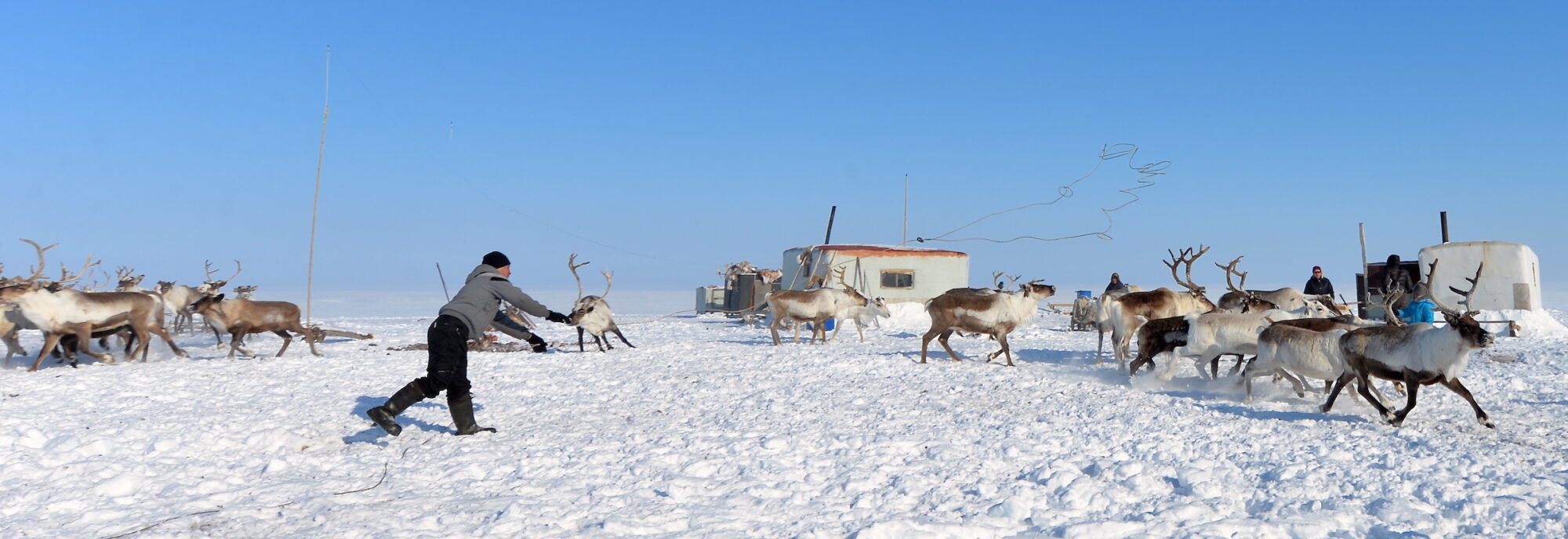
Overnight, the family's reindeer have moved further and further away from the Baloks in search of food. Holger is allowed to accompany Mikhail to drive the animals back with the help of the dogs. The men want to catch a few of the semi-domesticated animals - reindeer never become completely tame - to train for the upcoming sleigh race at the festival in Syndassko. The men skillfully throw their lasso at a reindeer. If they still miss, catch the wrong animal or one manages to free itself from the noose at the last moment, they laugh heartily. It takes a good hour to catch the dozen animals and put them in the harness.
Now Mikhail, Makar and Ivan are unstoppable. Out they go for training in the white infinity. Holger is also allowed to come along, but the dogs reluctantly have to stay behind. Ivan returns after just ten minutes. In a bend that he took too tightly, a runner is broken. The others return an hour later with icicles on their muzzles and hoods and a beaming smile on their faces. While the men mend Ivan's sled, I learn from the women how to make a wonderful brawn by boiling reindeer hooves for hours.
A little surprise. In the early evening, Spiridon returns from a visit to a neighbor. To everyone's surprise and delight, he pulls a small puppy out of his fur jacket. The three-month-old ball of wool comes from a female dog that Irina had once given to her neighbor. However, because of her good genes, Irina had asked for an offspring. I take delivery of the little one and notice that her whole body is shivering from the cold. She is christened Cuba by the children because of her mainly white fur, which has nothing to do with the country but means swan in their language. Cuba is soon toddling around and is carried around and cuddled by the children. At night, however, there is no respite: she sleeps outside in the cold anteroom, at least on a reindeer skin provided for her. When I ask Irina how the dogs are trained, she replies that no training is necessary. They have the work in their blood and learn from the other dogs. There are six dogs in the camp. A black one with a white collar, the boss, is completely fixated on Spiridon. He is always close to him. Watching the dogs round up the reindeer and lead the right animal to the roper is very impressive. They can hear the calls at a distance of several hundred meters. One evening, they even drive the reindeer back to the baloks without an order. The animals can satisfy their hunger with the frozen reindeer lungs, bones or food scraps that are always laid out in the snow. Regardless of the freezing temperatures, they spend day and night outside.
"There seems to be disagreement about the route. The directions straight ahead and then left are probably a bit vague."
Camp relocation. The next morning, Irina surprises us with the news that she has decided to move the camp to Syndassko in view of the upcoming festival. The women here are responsible for the relocation decision. Now we are curious to see how it works. Our only job is to put all the items in the Balok in boxes on the floor. That's done quickly. We let the stove go out, leaving the embers inside so that we can heat it up again as soon as we arrive. First, 37 reindeer have to be caught for the procession, which takes several hours. Makar brought his friend Oleg with him the evening before. So five men and the dogs get to work. The snow is removed from the two Baloks and they are put on the sledges.

Before the procession, everyone gathers for a late lunch. Then the reindeer are harnessed and off they go. Five compositions and the rest of the 200-strong reindeer herd make their way through untouched snow. Soon the slowly setting sun bathes the gentle landscape in a warm light. Holger and I are both jubilant with excitement: these images are reality and not a dream. Despite the cold, we are completely relaxed and full of trust in the careful care of our nomadic family.
At a spot chosen by Spiridon, the whole group stops and the new camp is quickly set up again. The sledges with their superstructures are positioned, the porches are attached, snow is shoveled onto the baloks, the stove is fed and tea is made.
Inside the balok, the bread dough that was made in the morning is already overflowing. The bread is not baked in an oven, but in a pot on the stove. Irina takes some of the dough and fries doughnuts without the filling. Today's starter is stroganina. Makar and Mikhail have removed the scales from four frozen fish outside. Using a large, sharp knife, they cut thin slices of fish that curl like shavings. Two of the fish still have orange roe in their bellies. Holger has the idea of filling the doughnuts with the roe, and a new delicacy is invented: Berliner with caviar filling. The second course is "Hörnli" with sliced reindeer meat. After dinner, Spiridon takes a bottle of spirit out of the storage box for the first time. First the spirits are thanked for the successful trip, and then they are asked for a happy stay at this stand. On this night, the color of the night sky is particularly impressive. Not only on the side of the sunset, but almost all around, the horizon is orange-yellow.
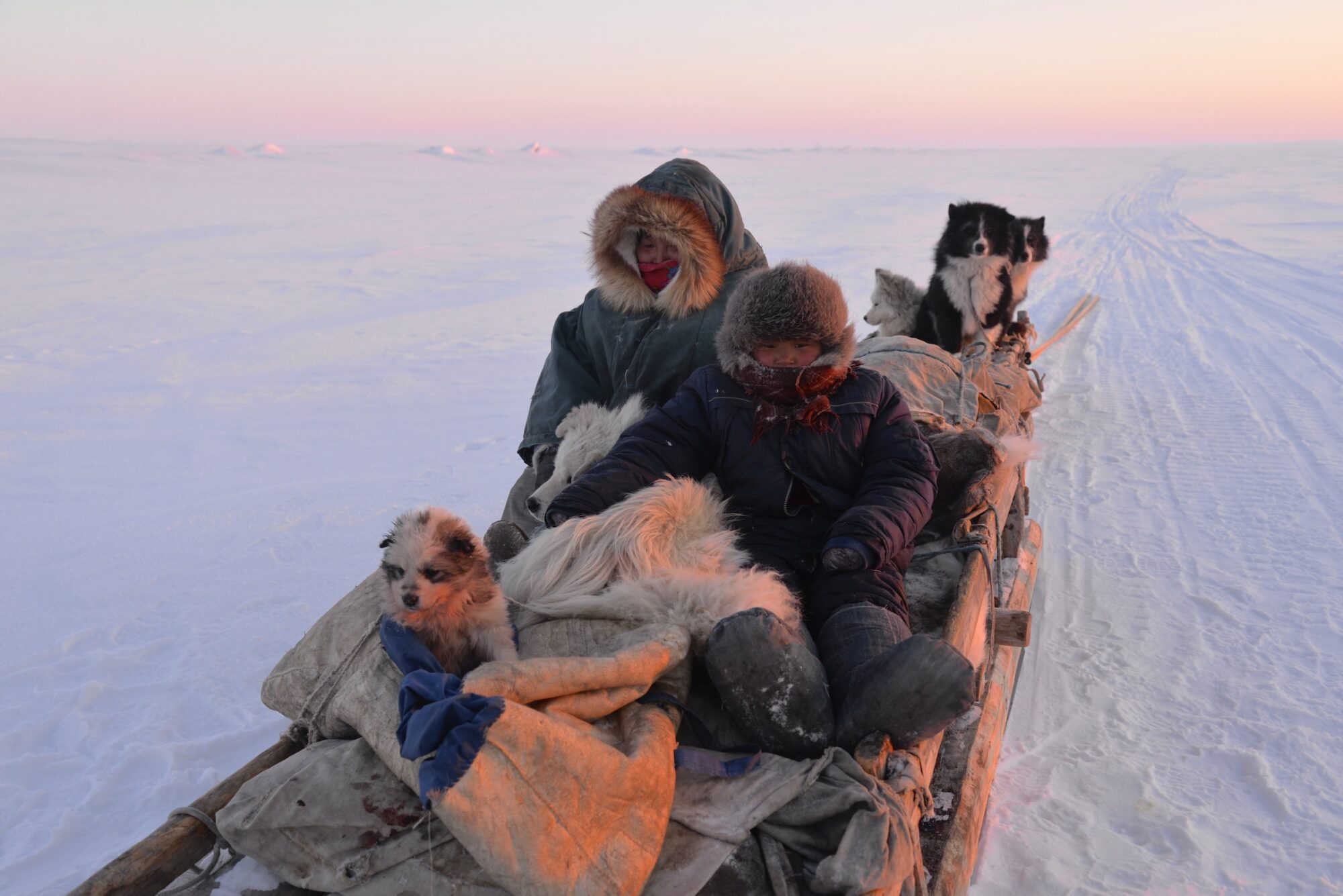
"Soon the setting sun bathes the gentle landscape in a warm light. Holger and I are both jubilant with excitement."
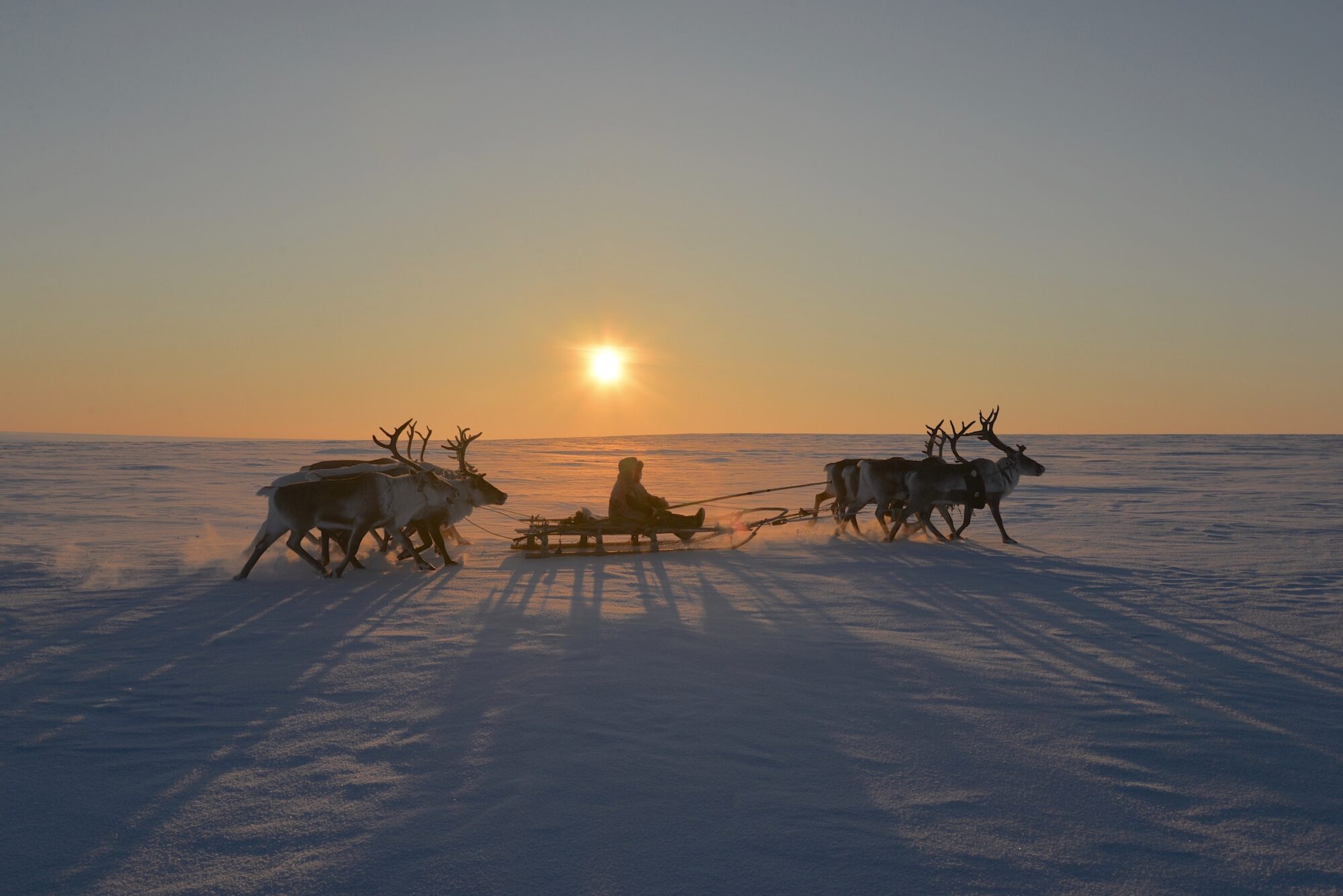
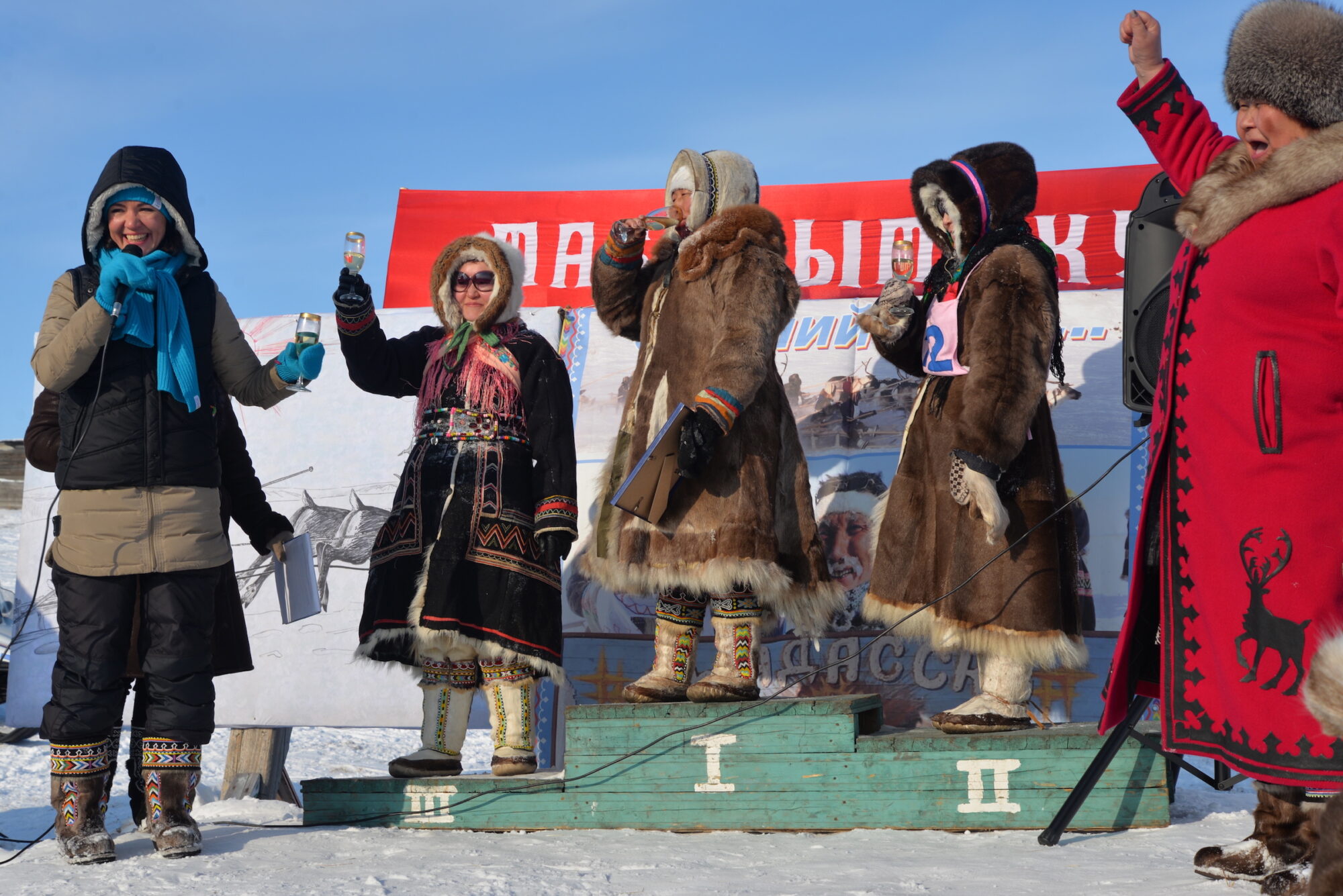
Festival preparations. One last reindeer sled training session is scheduled for the day before the festival. Dasha is training alongside the men today. Meanwhile, Irina prepares the festive outfits for the whole family. These consist mainly of reindeer and fox skins. She then skins a snow-white Arctic fox that Oleg killed with a trap the day before and stretches the fur on a prefabricated wooden board to dry. It is not of such good quality, as the winter was too mild for local conditions. The carcass has little meat and no fat and is not eaten anyway. The Dolgans believe that otherwise they won't catch any more foxes. Contrary to expectations, the dogs don't touch the meat either.
Towards evening we all drive to Syndassko together. Spiridon has tied the reindeer intended for the races to his sledge. Cuba is wrapped in a reindeer skin. The big dogs try to keep up with the sled. We glide over the never-ending expanse of snow, glistening in the last sunlight.
Anniversary. At the opening ceremony in the town hall, Holger and I are allowed to sit in the second row, directly behind the guests of honor and officials. Because Syndassko is celebrating its 85th anniversary, the young, attractive Minister of Culture from Krasnoyarsk, her entourage and some doctors have flown in by helicopter. The festival is an ideal opportunity to offer medical care to the otherwise widely dispersed nomads and to carry out vaccination campaigns. The majority of the event is taken up by speeches and the presentation of certificates of thanks. This is a custom dating back to the Soviet era, in which people who have made a contribution to the community are publicly recognized.
They then make their way to the festival site together, led by young Elvira, who rides a reindeer and is guided by her grandfather. Behind her, three women march with flags from Syndassko, the Krasnoyarsk region and Russia. The festival area consists of a podium and several baloks as well as a tipi-like tent, the Chum, where free local food is offered. The festival community is invited to eat and rate the food, as there is also a prize for the best cook. The competitions begin with the best dressed in the men's, women's and children's categories.
The three-man reindeer sleigh teams are brought into position for the men's race. "Our" Mikhail starts last. I get the impression that this is a clever strategy to avoid the chaotic start. The race lasts just under 15 kilometers. After half an hour, there is a dramatic finish. Three sledges fight for victory. Shortly before the finish, the multiple winner is relegated to third place. The winner is number 6: it's Mikhail! He is immediately surrounded and cheered by friends and family. Still completely out of breath, he can hardly believe it. He receives a cash prize of 300,000 roubles - the equivalent of a buran or 100 reindeer.
Dasha is less fortunate. The start of the women's race is frustrating for her. Her reindeer run in the wrong direction and cannot be persuaded to turn back, so she gives up. There is always a race going on somewhere, so we can't be everywhere. We are also impressed by the girls competing in lasso throwing. From a distance of five meters, they throw the lasso at a reindeer antler attached to a wooden post. One of them hits it three times in a row.
The festival was a complete success for Spiridon's family. Everyone agrees that we brought them luck. The next morning we say goodbye. Once again, we were able to get to know people in this endless landscape, which touched us deeply. It was certainly not the last time we visited nomads in the far north.
Dolgans as nomads
According to a census, there were 7011 dolgans in 2010. Although the majority of them still live as hunters and from agriculture, they have now settled down. Surviving as reindeer nomads is not easy here today. Because of the wild reindeer, the semi-domesticated herds are getting smaller every year. Due to climate change and the resulting changes in weather and vegetation, the routes of the numerous wild herds from the Taimyr Peninsula are no longer predictable. As soon as the semi-domesticated reindeer come into contact with such a herd, some join their wild counterparts and are then lost to the nomads. Because you can't turn wild reindeer into semi-wild ones. In order to increase the size of their own herds, they need to import semi-wild animals from other regions as well as their own offspring.
The reindeer nomads are also in trouble because politicians show little understanding for their concerns. They are not supported to the same extent as in Soviet times or in the neighboring republic of Yakutia, which is only 150 kilometers away. Spiridon's herd numbers just under 200 reindeer and is therefore rather small. Irina and Spiridon also receive a pension, which provides their family with some money. However, Irina is annoyed that it is "plastic money" that she can only withdraw in Chatanga, which takes four days. Outside Chatanga, there is neither a bank nor the possibility of paying by credit card, not to mention Internet access. As a result, the Dolgans in the Krasnoyarsk region are finding it difficult to survive as reindeer nomads. Dasha, her husband and children will therefore soon emigrate to Yakutia, where they have been hired as reindeer herders. The solution is sad on the one hand, but at the same time an opportunity. They can continue their nomadic life and culture, earn some money and still remain within visiting distance of their family.
The authors Sylvia Furrer (text) and Holger Hoffmann (photos) have traveled to 59 countries outside Europe since 1977. In recent years, they have become increasingly involved with traditional cultures and have repeatedly made private "research trips" to remote areas. They have already published several reports in Globetrotter magazine.

The authors Sylvia Furrer (text) and Holger Hoffmann (photos) have traveled to 59 countries outside Europe since 1977. In recent years, they have become increasingly involved with traditional cultures and have repeatedly made private "research trips" to remote areas. They have already published several reports in Globetrotter magazine.
This reportage first appeared in Globetrotter Magazine Switzerland. Never miss another issue and subscribe to Globetrotter magazine here.